

DANGER! THIN ICE
The trials and tribulations of being India’s fastest (and first) professional speed skater

Words by Radhika Iyengar
Photos by McCade Gordon
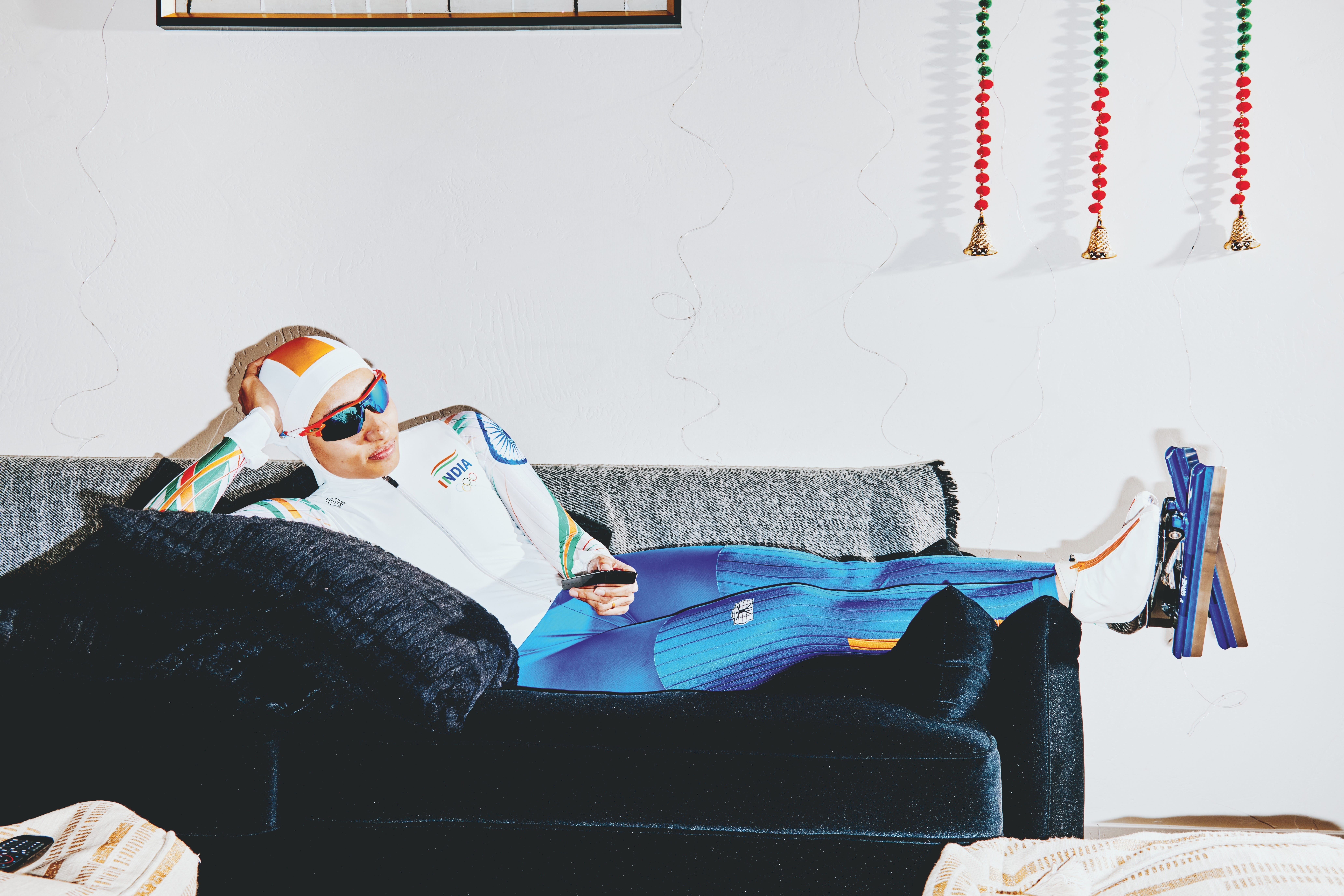
On ice, Shruti Kotwal has etched some of the most compelling chapters of her life. She’s the fastest speed skater from India – a brown athlete competing in a predominantly white sport, moving at a pace that tests the limits of human endurance.
Nearly a decade ago, Kotwal began pursuing speed skating with intention. She had no sponsors, no roadmap, and no clue how mentally and physically demanding the sport would be. Kotwal was born in Pune, a city of tropical heat and monsoon flourishes – a world miles away from the sub-zero arenas where the sport thrives. And, in a country where cricket is a national fixation, few have even heard of speed skating. So how did a young Indian woman become captivated by such an esoteric pursuit that she’d dedicate her life to chasing an elusive dream on ice? As the 2026 Winter Olympics in Milan approach we revisit our interview with Shruti from Ralph issue 06.

You began your journey as a roller-skater and won a few national medals in India. How did the transition from roller skating to ice skating happen?
It happened in 2008. I decided to take part in the National Winter Games in Gulmarg, Kashmir. My parents fully supported me. So I went and competed, except I had never ice skated before. I thought it would be similar to roller skating and that I’d be able to pick it up easily. But the moment I stepped out onto the ice, I realised how wrong I was. The rink was in poor shape and the temperatures were below freezing. It went so badly that I wanted to do it again. But I would have to wait another year to do this. In India at the time, there were no proper rinks, no training facilities. The next winter, the Ice Skating Association of India held a short camp in Shimla, and at the end of the camp they would host a national. So, I went. From then on, I went every winter – though “every winter” really meant just 10 days in a year because that’s all the ice we get. The rink over there was natural, so if the temperature didn’t drop enough, it simply wouldn’t form. And even when it did, the quality was so poor because there was no proper maintenance. But I kept going each year for the next four to five years, because I wanted to get better each time. Then I started winning the nationals one after another, and I began thinking that well, “now I’ve made it”. But little did I know.


And then came the invitation from the Ice Skating Union, a scholarship to train in Germany on the international stage.
Yes, I must have been 18 or 19 at the time. It was there, in a remote village in Germany, perched high up in the mountains, that I first laid eyes on a real international rink, an actual world-standard arena. The village was little more than an enclave for the athletes; no one else lived there. It was a place utterly foreign to me – remote, quiet and isolated.
Until that moment, I had never owned professional skates. In Germany, I finally glimpsed at what the sport looked like at its highest level. With that, came a humbling realisation: I knew nothing. India’s national standard, I understood then, was barely the starting point on the international scale.
I had never before encountered female athletes who were so strong and muscular – women whose entire lives revolved around the sport. Each skater followed a relentless training regimen, supported by masseuses and regular physio sessions. This is how champions are forged: through discipline, grit and bodies honed to perfection.
Can you walk me through what it takes to qualify at the highest level in your sport?
This sport isn’t about miracles. My personal best in the 500 metres is 41 seconds but I have to skate under 40 seconds – basically, anything around 39.9 or lower to even be in contention. The sport is so precise, it comes down to hundredths of a second. And I have been chasing those two seconds for the past three years. I haven’t beaten my personal best in that time and it’s frustrating being stuck at the same mark year after year. People outside this world don’t always understand what two seconds mean. In our sport, two seconds can be the difference between standing in the top ten and being nowhere near it. So, at 41 seconds, I feel very far from that elite mark. Every race, every hundredth of a second, feels monumental.

While you’re obviously a serious athlete, there’s also this playful side to you which you’ve begun sharing on social media – moments where you dance or just let yourself be a little silly. I love seeing that side of you, the human side of you beyond the skating.
That’s simply who I am. I’ve always had a playful side, but for a long time, I didn’t show it. I was very camera shy and reserved. Over the past few years, however, my perspective has shifted. I’ve developed a more confident, “this is me” attitude. For so long, I was trying to fit in – in India, Canada and now in the United States. Years of homesickness and adjustment left me questioning where I truly belonged. Even now, my parents have only recently seen me speed skate in person. I’ve spent my entire career on the ice, and they only recently witnessed it, because until now, they didn’t have a visa to visit the United States. That’s why I allow myself to share these lighter moments online – the dancing, the quirks, the humour. They’re a reflection of who I am beyond the ice. They’re just me being me, finally.
This is an edited version of the article, which originally appeared in Ralph issue 06. To read the full feature get your copy here!
Absolutely phenomenal piece! The detail about chasing two seconds for three years really hits home how brutal precision sports are. I remeber training for a half-marathon and obsessing over minutes, but hundredths of a second is a differnet level of mental game. The contrast between her playful social media persona and the grinding discipline required for elite competition is fascinating.